The Ultimate Guide to Stock Management in FMCG & CPG — Why an Effective Stock Management System Is No Longer Optional
Struggling with stockouts or excess inventory? Explore why stock management systems are critical for FMCG & CPG and how FieldAssist simplifies execution.

Are you always chasing stock updates across warehouses, distributors, and retail outlets?
Do you sometimes discover a stockout only after a retailer complains or excess inventory only when expiry becomes a risk?
If you work in the FMCG or CPG industry, this probably sounds familiar.
Managing inventory today isn’t just about counting stock. Products move quickly from manufacturer to distributor to retailer and finally to the consumer. Along the way, teams deal with thousands of SKUs, frequent demand changes, tight margins, and strict expiry timelines. One missed update or delayed decision can quickly turn into lost sales or wasted inventory.
That’s where a stock inventory management system comes in. Let’s start by understanding why stock management has become such a high-stakes function in FMCG and CPG operations.
What Is Stock Management and Why It Matters?
Stock management software is a tool helping businesses track inventory in real time, monitor stock levels across locations, and manage replenishment automatically. It helps businesses avoid stockouts, excess inventory, and data inaccuracies by replacing manual tracking with precise, system-led visibility. It ensures the right products are in the right place at the right time, with the right quantities.
A powerful system stock management strategy seeks to:
- Prevent under-stock (leading to missed sales)
- Avoid over-stock (tying up capital and increasing storage costs)
- Improve customer satisfaction through better availability
- Real World Impact of Poor Stock Management
As of 2025, over 43% of businesses cite inventory management as their biggest operational challenge with 70% of them losing customers due to stockouts resulting in missed revenue opportunities and diminished customer trust.
Meanwhile, industry estimates show that overstocking costs businesses between 20% to 30% of their value annually largely due to storage costs, wastage, and capital lock-in.
These numbers make it clear: poor stock inventory management directly harms your bottom line.
From Manual Processes to Stock Inventory Management Systems
Retailers traditionally used manual or spreadsheet-based methods to track inventory. These approaches might work at smaller scales, but they fall short in today’s omni-channel retail world where real-time data, rapid replenishment, and precise forecasting are must.
Here enters digital stock inventory management software. These systems automate various tasks such as:
- Inventory counting and reconciliation
- Sales and demand forecasting
- Reorder alerts and replenishment planning
- Multi-location stock tracking
- Warehouse and store synchronization
Key Benefits of Using a Modern Stock Inventory Management System
A modern stock inventory management system goes far beyond basic stock tracking. For FMCG and CPG businesses operating at scale, it becomes a critical lever for cost control, execution efficiency, and growth. Mentioned below are some of the most important benefits in practical terms.
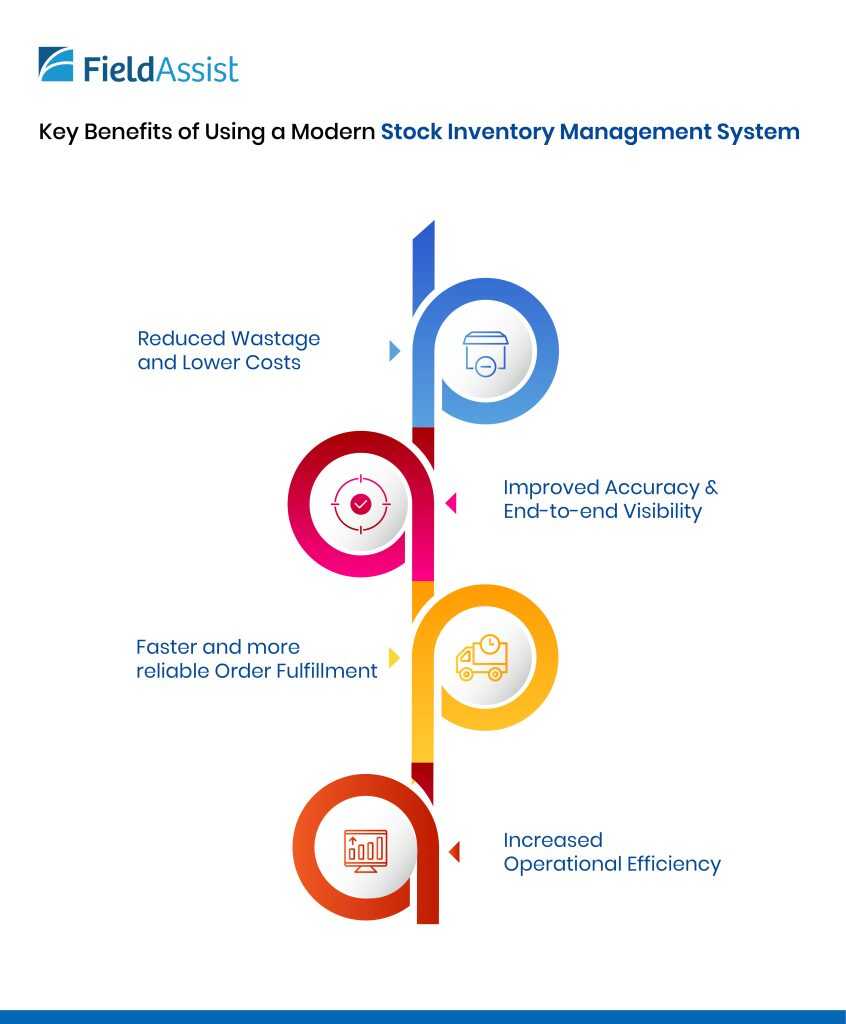
Reduced Wastage and Lower Costs
Real-time stock tracking and automated replenishment is only enabled by a modern stock management system, helping FMCG businesses avoid overstocking and expiry losses. This improves inventory turnover, reduces costs and frees up working capital across warehouses and distributors.
Improved Accuracy & End-to-end Visibility
Stock management software offers precise, real-time inventory visibility across warehouses, distributors, and retail locations by replacing manual tracking with automated updates. This eliminates stock mismatches, improves planning reliability, and ensures teams operate using a single source of truth.
Faster and more reliable Order Fulfillment
Real-time inventory visibility allows businesses to process orders faster and with higher accuracy. Automated reorder triggers help prevent stockouts, while system-led order validation ensures smoother fulfillment cycles and consistent product availability across distribution and retail networks.
Increased Operational Efficiency
A centralized stock inventory management system reduces manual reconciliation and reporting effort. Sales, supply chain, warehouse, and distribution teams work on shared data, enabling better coordination, faster replenishment, and more efficient use of manpower across locations.
Cloud-based systems further enhance this efficiency by enabling real-time decision-making across locations from head office to warehouses and last-mile distribution points.
Why Stock Management Is Critical for FMCG /CPG — The Stakes Are High
FMCG and CPG supply chains operate at an unmatched scale, with millions of units moving across factories, warehouses, distributors, and retail outlets every day. This scale makes stock management one of the most critical operational levers for profitability and growth.
The Scale of FMCG Supply Chain Operations
As per the reports, The global FMCG market was valued at USD 14.1 trillion in 2024 and is expected to expand from USD 14.63 trillion in 2025 to USD 19.72 trillion by 2033, registering a CAGR of 3.8% over the forecast period. Highlighting the sheer volume of goods, transactions, and inventory being managed across markets and channels. At this scale, even minor inefficiencies in a stock management system can translate into significant financial losses.
The Cost Pressure Behind Inventory Decisions
Supply-chain operations account for nearly 70% of total operational costs for a typical FMCG company. This includes procurement, warehousing, transportation, inventory holding, returns, and wastage. Since inventory sits at the center of all these activities, ineffective system stock management directly inflates operating costs and erodes margins.
The Process Gap: High Stakes, Low Digital Adoption
Despite the size and cost of FMCG supply chains, the report says In the CPG industry, supply chains are still managed using fragmented legacy and home-grown tools. Around 61% of executives rely on multiple legacy systems, ERPs, and spreadsheets limiting supply-chain maturity and performance.
Why This Gap Creates Operational Risk
This imbalance between high operational stakes and outdated stock management practices creates serious vulnerabilities:
- Manual stock tracking increases the risk of stockouts and excess inventory
- Delayed visibility prevents timely replenishment decisions
- Inaccurate inventory data leads to lost sales, higher write-offs, and distributor dissatisfaction
- Scaling operations becomes difficult without a centralized stock inventory management system
In a high-velocity FMCG environment, where demand patterns change rapidly and margins are tight, businesses cannot afford reactive inventory decisions. Modern stock management software is no longer a support function—it is a core enabler of supply-chain efficiency, cost control, and execution excellence.
Introducing FieldAssist DMS Retail: Transforming System Stock Management
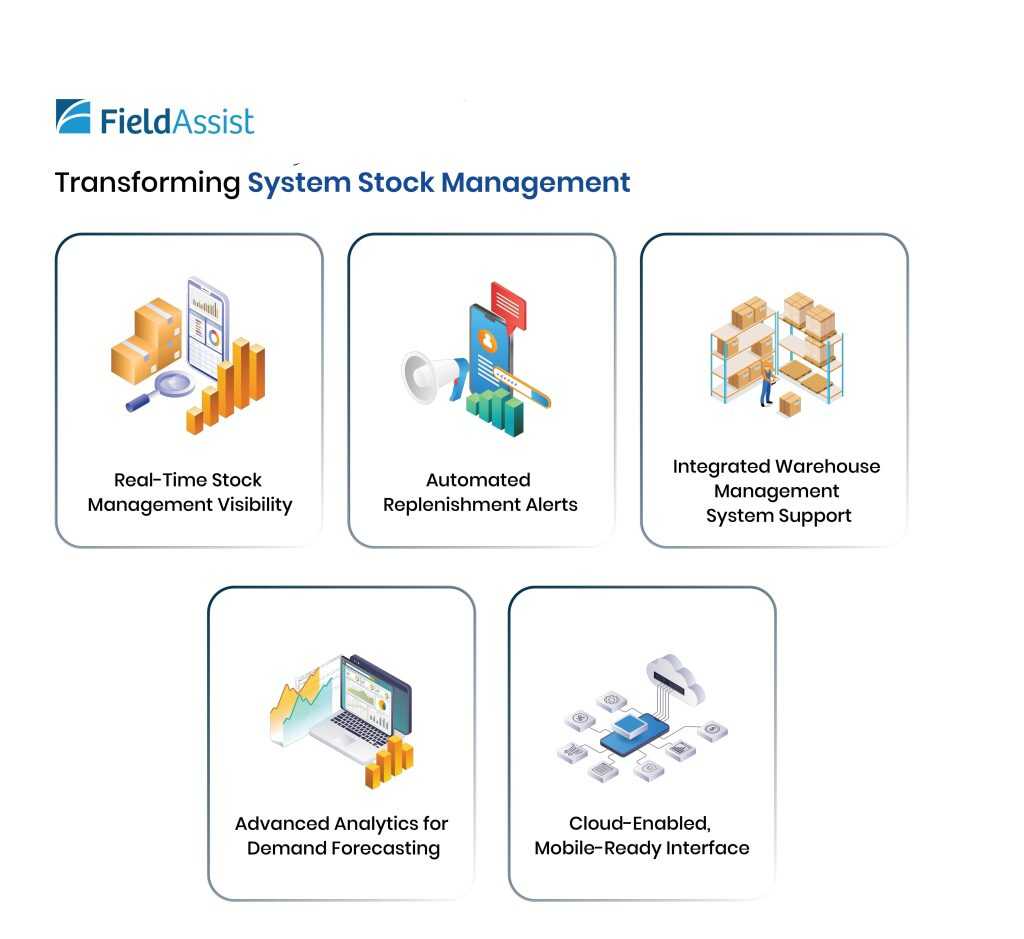
As FMCG and retail operations grow more complex, stock management system requires real-time visibility, automation, and control across the entire network. FieldAssist DMS Retail brings these capabilities together in one platform, enabling accurate inventory tracking, timely replenishment, and seamless coordination between stores, warehouses, and distribution points.
Real-Time Stock Management Visibility
FieldAssist provides real-time visibility into stock levels across stores, warehouse hubs, and distribution points. This eliminates blind spots, improves stock accuracy, and enables faster, data-driven decisions for replenishment, transfers, and availability planning.
Automated Replenishment Alerts
FieldAssist uses predefined reorder thresholds and intelligent replenishment triggers to ensure high-demand SKUs are restocked on time. This reduces stockouts, maintains consistent shelf availability, and supports uninterrupted sales across retail and distribution networks.
Integrated Warehouse Management System Support
By integrating warehouse workflows with retail and distributor operations, FieldAssist creates a unified stock management system. This ensures seamless stock movement, accurate inventory records, and better coordination between warehouse dispatch, distribution, and store-level availability.
Advanced Analytics for Demand Forecasting
FieldAssist’s analytics engine analyzes historical sales and inventory data to forecast demand more accurately. This helps retailers and brands plan inventory for seasonal peaks, promotions, and regional demand variations, reducing both shortages and excess stock.
Cloud-Enabled, Mobile-Ready Interface
The cloud-based, mobile-ready interface allows field teams to manage inventory, record stock movements, and transfer goods in real time. This ensures continuous stock visibility and control across geographically dispersed retail and distribution operations.
How FieldAssist DMS Retail Solves Everyday Stock Management Challenges
Day-to-day stock management challenges often arise from process gaps, disconnected systems, and limited visibility across the supply chain. FieldAssist addresses these issues at an operational level, helping teams simplify execution, align data across functions, and maintain control over inventory across warehouses, distributors, and retail outlets.
Businesses leveraging advanced stock management software can achieve measurable gains including lower inventory costs, improved accuracy, and higher sales and FieldAssist extends these capabilities with retail-centric workflows.
Measurable Business Impact of a Modern Stock Inventory Management System
Studies published by Research Gate highlight that modern stock inventory management systems deliver measurable gains in inventory accuracy, cost reduction, stock availability, and working capital efficiency through real-time visibility and automation.
- Research indicates that modern stock management systems can increase inventory accuracy by 25–35%, significantly reducing mismatches between physical stock and system records.
- Improved planning and controlled replenishment through digital systems lead to a 20–30% decline in inventory carrying costs, driven by lower excess stock and reduced holding periods.
- Organizations using real-time inventory tracking report a 35–45% reduction in stockout occurrences, ensuring better product availability across warehouses and retail outlets.
- Combining real-time monitoring with historical sales data helps businesses improve demand forecasting accuracy by up to 40%, supporting more reliable inventory planning.
- Automated reordering workflows cut manual inventory processing time by nearly 60%, freeing teams from repetitive tasks and improving overall operational efficiency.
- Cloud-based inventory platforms enhance visibility and control, resulting in 15–25% better working capital utilization through optimized stock levels and faster inventory turnover.
How to Choose the Best Stock Management System?
Choosing the right stock management system requires aligning technology capabilities with business scale, industry needs, and future growth plans. Key factors to evaluate include:
Industry Fit
The stock management system should be purpose-built for FMCG or retail operations, supporting distributor-led supply chains, batch and expiry tracking, returns handling, and high SKU velocity. Industry alignment ensures smoother implementation and relevance to real operational challenges.
Scalability
Stock management software must scale seamlessly as product assortments, outlet count, and transaction volumes increase. A scalable system supports business growth without performance issues, frequent reconfiguration, or operational disruption across warehouses and distribution networks.
Real-Time Visibility
Real-time inventory visibility ensures businesses always know what stock is available, where it is located, and how fast it is moving. This capability enables proactive replenishment, reduces stockouts, and supports faster, more accurate decision-making.
Integration Capabilities
Seamless integration with ERP, accounting, billing, and sales systems is critical for unified operations. Integrated platforms eliminate data silos, reduce manual reconciliation, improve data accuracy, and ensure consistent information across inventory and financial workflows.
Analytics and Forecasting
Advanced analytics and demand forecasting help businesses identify trends, seasonal patterns, and slow-moving inventory. These insights improve planning accuracy, reduce excess stock, and enable smarter inventory allocation across regions and channels.
Ease of Use
Ease of use is essential for adoption by on-ground teams, distributors, and store staff. Intuitive interfaces, mobile access, and automated workflows reduce manual effort, improve compliance, and ensure consistent data capture across locations.
Closing Thoughts
In FMCG and CPG, stock management directly determines revenue, cost efficiency, and customer trust. With high SKU velocity, tight margins, and expiry-driven risks, manual tracking and fragmented systems can no longer support scalable operations. Businesses need real-time visibility, automated replenishment, and a unified view of inventory across warehouses, distributors, and retail outlets to stay competitive.
FieldAssist enables this shift by delivering a centralized, real-time stock management system that connects inventory, warehouse operations, and retail execution on a single platform. It helps FMCG and CPG businesses protect margins and scale with confidence.
If your business is facing similar challenges it’s time to move beyond spreadsheets.
Connect with FieldAssist to see how a modern stock management system can bring control and efficiency to your business.
Frequently Asked Questions (FAQs)
What is the difference between stock management and inventory management?
In practical terms, there is no major difference. Stock management focuses on tracking and controlling products at warehouses, distributors, and retail outlets, while inventory management is often used as a broader term that includes planning, forecasting, and replenishment. In FMCG and CPG, both refer to managing product availability efficiently across the supply chain.
When should an FMCG or CPG company invest in a stock management system?
A business should invest in stock management software when it starts facing frequent stockouts, excess inventory, delayed replenishment, or heavy dependence on spreadsheets. In practice, once SKU count, distributor network, or geographic spread increases, manual processes no longer scale reliably.
Can a stock management system reduce expiry and wastage in FMCG?
Yes. A modern stock inventory management system tracks stock at batch and expiry level, enabling First In, First Out (FIFO)-based movement and proactive clearance planning. This significantly reduces expiry-related write-offs, especially in categories with limited shelf life such as food, personal care, and beverages.
How is FieldAssist DMS Retail different from generic stock management tools?
FieldAssist DMS Retail is designed specifically for FMCG and CPG distribution. It combines stock inventory management software, distributor workflows, warehouse integration, and real-time analytics in one platform—bridging the gap between planning and on-ground execution that generic tools often miss.



.avif)